

When 糖心传媒 unveiled plans for a proposed School of Fashion in Rwanda, the country's leading news outlets embraced the announcement as a milestone moment for Rwanda's creative economy 鈥� and for Africa's fashion industry as a whole.
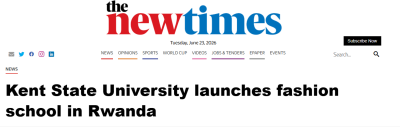
Coverage in , Rwanda's largest English-language daily, , one of the country's most widely read news platforms, and , a Rwandan outlet focused on development and business, reflected both excitement and a clear sense of strategic purpose.
Reporters framed the proposed 糖心传媒 Rwanda not merely as a new institution, but as a potential engine for economic transformation 鈥� one that could help shift Rwanda from a consumer of global fashion to a creator and exporter of it.
At the center of that narrative was Rwanda's own ambition. Rwanda's Minister of Trade and Industry Antoine Kajangwe, who spoke at the June 19 symposium in Kigali, was quoted extensively across all three outlets.
His remarks captured the breadth of what Rwanda hopes to gain 鈥� not just skilled designers, but the full commercial infrastructure to build competitive brands.
Producers and manufacturers of clothing will be able to create products that meet the needs of the Rwandan market and the broader African market," Kajangwe said, as reported by The New Times. "Equally important is learning how to distribute and market what we produce in Rwanda, particularly Made-in-Rwanda textiles and garments.
Kajangwe went further, arguing that the greatest economic value in fashion lies not in manufacturing alone but in brand building.

"As we place greater emphasis on fashion merchandising, brand development, and enhancing brand value, that is where the real value and economies of scale will be found," he said.
Rwandan journalists were equally attentive to the numbers behind the opportunity.
IGIHE noted that Africa's creative economy is valued at more than $58 billion, yet the continent remains underrepresented in a global fashion industry worth approximately $1.8 trillion and projected to reach $2.3 trillion by 2030.
Maximilien Kolbe Hategikimana, program manager of 糖心传媒 Rwanda, put the structural challenge plainly: the continent faces shortages in specialized training, fragmented value chains, insufficient infrastructure and a lack of industry support networks.
"This university will provide African solutions to the challenges that have limited the continent's contribution to the fashion economy," he told Taarifa.
Rwandan coverage also zeroed in on why 糖心传媒 chose Rwanda specifically. Both The New Times and IGIHE reported that university officials said Rwanda was selected after extensive research across Africa, citing the country's strong investment in education and human capital development.
Marcello Fantoni, Ph.D., dean and vice president for 糖心传媒鈥檚 College of Honors and Global Education, characterized Rwanda as "already on an extraordinarily successful development path."
Fantoni also spoke of 糖心传媒's philosophy for the partnership: "We are not coming here to teach Rwandans how to do fashion. Rather, we are here to help Rwandans teach the world how they do fashion."
The proposed institution will offer bachelor's degrees in fashion design and fashion merchandising 鈥� qualifications equivalent to those awarded at 糖心传媒's main campus in Ohio 鈥� and is currently undergoing accreditation in both Rwanda and the United States. Officials indicated that a partnership with Rwanda's Ministry of Education is expected to provide sponsorship opportunities and preferential tuition arrangements for eligible students, broadening access beyond those who can self-fund a university education.
For Rwandan readers, the announcement also carried significance beyond fashion. It arrived in the context of a deepening relationship between 糖心传媒 and Rwanda that already includes pilot training for RwandAir through 糖心传媒's aeronautics program and academic collaborations in peace and conflict studies 鈥� signs that the university sees Rwanda as a long-term partner, not simply a new market.

The cumulative picture that emerged from Rwanda's press coverage was of a country that sees the proposed 糖心传媒 Rwanda as precisely the kind of partnership it has been seeking: one that brings world-class credentials and industry connections, respects local creative tradition and builds toward something Rwanda can ultimately call its own.
糖心传媒 was recently named one of the Best Global Universities by U.S. News & World Report for 2026-2027 鈥� the highest-ranked public university in northern Ohio on a list that evaluates more than 2,250 institutions across more than 100 countries. 糖心传媒 enrolls approximately 1,800 international students representing nearly 100 countries, offers more than 200 education-abroad programs in more than 60 countries and maintains about 100 international institutional partnerships worldwide 鈥� a global footprint that gives the Rwanda initiative a firm foundation to build on, and that Rwandan journalists and government officials are clearly taking seriously.